
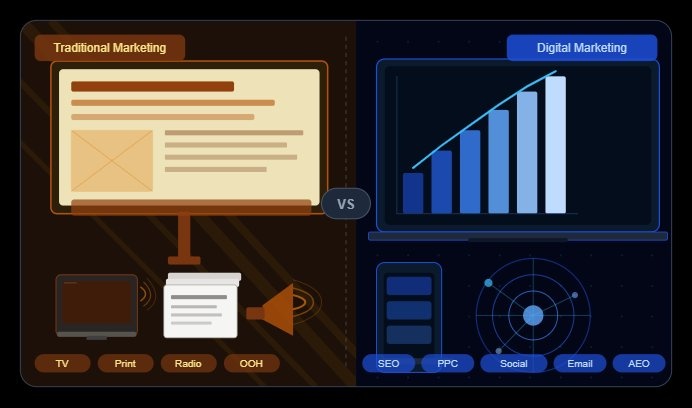
Digital marketing is generally better for B2C brands in 2025 because it is more targeted, more measurable, and more cost-effective than traditional marketing. It lets brands reach the right customer at the right moment across search, social media, email, and video — and track every result. Traditional marketing (TV, print, radio, outdoor) still has value for brand awareness at scale, but digital marketing consistently delivers higher ROI, faster feedback, and more precise audience targeting for most B2C businesses. The best strategy combines both, with digital as the foundation.
Contents
- 1 Why This Question Matters More Than Ever in 2025
- 2 What Is Traditional Marketing? A Plain-English Breakdown
- 3 What Is Digital Marketing? A Plain-English Breakdown
- 4 Digital Marketing vs Traditional Marketing: Head-to-Head Comparison for B2C Brands
- 5 Which Is Better for B2C Brands? The Honest Answer
- 6 What Smart B2C Brands Are Actually Doing in 2025
- 7 Digital Marketing ROI vs Traditional Marketing ROI: What the Data Shows
- 8 How the Digital vs Traditional Balance Differs Across B2C Sectors
- 9 How to Decide: A Framework for B2C Brands
- 10 Digital Marketing for B2C Brands in Chennai: What the Local Market Requires
- 11 Common Mistakes B2C Brands Make When Choosing Between Digital and Traditional Marketing
- 12 Frequently Asked Questions
- 12.1 Is digital marketing better than traditional marketing for B2C brands?
- 12.2 What is the biggest difference between digital and traditional marketing?
- 12.3 Which marketing channel has the best ROI for B2C brands?
- 12.4 Can small B2C brands compete with large brands digitally?
- 12.5 What is the role of SEO in B2C marketing?
- 12.6 What is AEO and why should B2C brands care about it in 2025?
- 12.7 How do B2C brands measure the success of traditional marketing?
- 12.8 Should a B2C brand use influencer marketing?
- 12.9 How do I find the best digital marketing freelancer in Chennai for my B2C brand?
- 12.10 What digital marketing channels should a B2C brand prioritize first?
- 13 Final Verdict: Digital Marketing Wins for B2C Brands — With Smart Exceptions
Why This Question Matters More Than Ever in 2025
Every B2C brand faces the same challenge. Where should the marketing budget go?
Traditional marketing has been around for over a century. TV commercials, newspaper ads, radio spots, billboards, and direct mail all built some of the world’s biggest consumer brands. They still work. But they are expensive, hard to measure, and slow to adjust.
Digital marketing changed everything. Search ads, social media campaigns, email newsletters, influencer partnerships, and video content gave brands a new way to reach consumers. A way that is faster, cheaper, more measurable, and more personal.
But the debate is not as simple as old versus new. For B2C brands specifically, the question is not which approach exists but which one delivers better business outcomes for your specific product, audience, and budget.
This article answers that question. We cover what both marketing approaches actually involve, how they compare across the dimensions that matter most for B2C businesses, where each one wins, and how smart brands are combining them in 2025 to grow faster than their competitors.
If you are looking for a best digital marketing freelancer in Chennai to help you execute a strategy, the principles in this article will help you have smarter conversations and make better decisions before you hire anyone.
What Is Traditional Marketing? A Plain-English Breakdown
Traditional marketing refers to any promotion that happens through offline channels. These are the channels that existed before the internet.
The Main Channels of Traditional Marketing
Television advertising: TV commercials reach mass audiences during popular programs. They are expensive to produce and broadcast, but they build brand recognition quickly at scale.
Print advertising: Ads placed in newspapers, magazines, brochures, and catalogs. Print still reaches specific demographics, particularly older audiences who trust printed media.
Radio advertising: Audio ads broadcast during radio programs. Radio reaches commuters, local audiences, and specific demographic groups effectively.
Outdoor advertising: Billboards, bus stop panels, transit ads, and hoardings. Outdoor advertising delivers repeated impressions to people in specific geographic areas.
Direct mail: Physical catalogues, postcards, and promotional materials sent to consumers’ homes. Direct mail has higher engagement rates than many digital channels when done well.
Event and sponsorship marketing: Brand presence at physical events, trade fairs, sports sponsorships, and community activities.
The Core Strengths of Traditional Marketing for B2C Brands
Traditional marketing is not dead. It has real strengths that digital channels cannot fully replicate.
Mass reach is the biggest advantage. A primetime TV commercial in India can reach tens of millions of viewers in a single evening. No digital campaign can replicate that scale of simultaneous reach. For brands launching in a new market or doing a big seasonal push, television and outdoor advertising build awareness faster than any digital channel.
Traditional media also carries credibility. Consumers who grew up trusting newspapers and television ads often perceive brands that advertise on these channels as more established and reliable. This trust factor is significant in certain product categories, especially healthcare, financial services, and premium consumer goods.
Finally, traditional media is unavoidable in a way that digital media is not. You cannot install an ad blocker on a billboard. You cannot skip a radio ad when you are driving. Passive exposure still has value for brand building.
The Core Weaknesses of Traditional Marketing for B2C Brands
The weaknesses are significant and they hurt B2C brands in ways that matter.
Cost is the biggest barrier. A thirty-second television commercial during primetime Indian programming can cost anywhere from a few lakhs to several crores, depending on the channel and time slot. Print ads in major national publications are similarly expensive. These costs put traditional media out of reach for most small and mid-size B2C brands.
Measurement is the second major weakness. How many people saw your billboard? How many television viewers actually watched your commercial and then went on to buy your product? These questions are almost impossible to answer with precision. Traditional marketing relies on estimated reach figures and post-campaign surveys, not real data.
Speed and flexibility are also problems. A newspaper ad has to be booked days or weeks in advance. A television campaign requires weeks of production. If the campaign is not working, you cannot adjust it quickly. You are committed to what you built.
What Is Digital Marketing? A Plain-English Breakdown
Digital marketing covers every promotional activity that happens through digital channels and the internet. It is broader than most people realize.
The Main Channels of Digital Marketing
Search Engine Optimization (SEO): The process of making your website rank higher in Google’s organic search results for the keywords your customers are searching for. SEO drives free, high-intent traffic.
Pay-Per-Click Advertising (PPC): Paid ads on Google, Bing, and other search engines. You pay when someone clicks your ad. Google Ads is the dominant PPC platform for most B2C brands.
Social Media Marketing: Both organic content and paid advertising on platforms like Instagram, Facebook, YouTube, LinkedIn, and emerging platforms like Threads. Social media is where B2C brand relationships are built.
Email Marketing: Direct communication with customers and prospects through email. Email delivers the highest ROI of any digital marketing channel when done well.
Content Marketing: Creating and distributing valuable content (blog posts, videos, guides, podcasts) that attracts and retains an audience and supports organic search visibility.
Influencer Marketing: Partnering with content creators and social media personalities who have established audiences that trust their recommendations.
Video Marketing: YouTube, Instagram Reels, and short-form video content that builds brand awareness, educates buyers, and drives conversions.
Answer Engine Optimization (AEO): Optimizing content so AI tools like Google SGE, ChatGPT, and Perplexity cite your brand in their responses. An increasingly important channel in 2025.
The Core Strengths of Digital Marketing for B2C Brands
Digital marketing has five strengths that fundamentally change how B2C brands can compete.
Precision targeting is the first. Digital platforms let you target ads and content to exactly the right people. Age, gender, location, interests, purchase behavior, device type, time of day, and dozens of other variables can be used to make sure your message reaches the people most likely to buy. Traditional marketing targets audiences in broad strokes. Digital marketing targets individuals.
Measurability is the second. Every digital marketing action generates data. You can see exactly how many people saw your ad, how many clicked, how many visited your website, how many added to cart, and how many completed a purchase. This level of visibility is impossible with traditional marketing. It means you can prove what works and stop what does not.
Cost efficiency is the third. A well-run Google Ads or Meta Ads campaign for a B2C brand can deliver qualified traffic and leads at a fraction of the cost of equivalent television or print advertising. For small and mid-size B2C brands, digital marketing makes reaching your ideal customer affordable.
Speed and agility are the fourth. A digital campaign can be live within hours. If it is not performing well, you can adjust targeting, change creative, pause spending, or try a completely different approach within minutes. Traditional marketing commits you to a plan for weeks or months at a time.
Personalization is the fifth. Digital marketing allows B2C brands to deliver different messages to different audiences based on where they are in the buying journey. A customer who has never heard of your brand sees a different message than a customer who abandoned their cart yesterday. This level of personalization is only possible digitally.
The Core Weaknesses of Digital Marketing
Digital marketing is not perfect. B2C brands need to understand the real challenges before committing fully.
Digital fatigue is real. Consumers see hundreds of digital ads every day. Standing out in a crowded feed requires creative excellence and constant testing. Simply running ads is not enough.
Algorithm dependency is a risk. Organic reach on social media and search rankings can shift based on platform algorithm changes that are outside your control. Brands that rely entirely on one digital channel are vulnerable.
Short attention spans make some digital formats less effective for brand storytelling. A banner ad or a fifteen-second pre-roll video does not create the same emotional depth as a well-crafted sixty-second television commercial.
Technical complexity is also a barrier for many B2C businesses. Running effective SEO, paid media, and email marketing simultaneously requires either in-house expertise or the support of a skilled digital marketing freelancer or agency.
Digital Marketing vs Traditional Marketing: Head-to-Head Comparison for B2C Brands
Here is a direct comparison across the dimensions that matter most for B2C businesses.
| Digital Marketing | Traditional Marketing |
| Highly targeted by behavior, interest, location, demographics | Broad reach, limited targeting precision |
| Fully measurable — clicks, conversions, ROAS, revenue | Estimated reach, difficult to attribute sales |
| Low to medium cost — scalable from any budget | High cost — especially TV, print, outdoor |
| Real-time — adjustable within hours or minutes | Slow — weeks of lead time, hard to change mid-campaign |
| Personalized messaging for each audience segment | One message for a broad audience |
| Two-way — customers can engage, share, respond | One-way broadcast with no real interaction |
| Builds long-term assets (SEO, email lists, content) | Does not build owned assets |
| Requires technical skills and ongoing management | Simpler to execute once budget is confirmed |
| Strong for conversion and retention stages | Strong for mass awareness at scale |
| Global or hyper-local reach | Primarily local or national depending on media |
Which Is Better for B2C Brands? The Honest Answer
The short answer is that digital marketing wins for most B2C brands in 2025. But the full answer is more nuanced.
Here is why digital marketing has become the foundation of B2C brand growth.
B2C Buying Happens Online First
The modern B2C buying journey almost always starts with a search, a social media scroll, or a recommendation from an online creator. Even when a customer buys in a physical store, they very likely researched the product online first.
This means that if your brand is not visible in digital channels, you are invisible at the most important stage of the buying decision. SEO, paid search, and social media presence are not optional. They are where the customer’s journey begins.
Digital Marketing Scales With Your Budget
A small B2C brand with a limited marketing budget cannot afford a primetime television slot. But they can run a precisely targeted Instagram campaign for Rs. 500 per day. Digital marketing democratizes access to effective advertising. Any B2C brand, regardless of size, can compete for attention digitally.
As budget grows, digital marketing scales efficiently. You can increase spend on what works and cut what does not, with the data to guide every decision.
Digital Marketing Builds Long-Term Assets
A television campaign ends when the budget runs out. A well-executed SEO strategy and an email list are assets that keep delivering value long after the initial investment. Content that ranks on Google keeps generating free traffic for years. An email list of 50,000 engaged subscribers is worth more than almost any single advertising campaign.
Digital marketing, done well, builds compounding value over time. Traditional marketing resets to zero every time a campaign ends.
When Traditional Marketing Still Makes Sense for B2C Brands
There are situations where traditional marketing remains genuinely valuable, even in 2025.
Mass brand launches: When a B2C brand is entering a new market and needs to build awareness among a very large audience very quickly, television and outdoor advertising can do this more efficiently than digital channels.
Older demographic targeting: Consumers over 55 in many markets still spend more time with traditional media. If your B2C product is specifically targeted at this demographic, print and television remain effective channels.
Trust and credibility building: In markets where consumers are skeptical of online advertising, traditional media can establish brand credibility faster. This is particularly relevant in financial services and healthcare categories.
Local market saturation: In certain Indian cities and towns where digital penetration is still growing, outdoor advertising, local radio, and regional newspapers reach audiences that are harder to reach digitally.
Premium brand positioning: Some luxury B2C brands deliberately maintain a presence in high-quality print publications to reinforce their premium status. The exclusivity of print can serve brand positioning goals.
What Smart B2C Brands Are Actually Doing in 2025
The most successful B2C brands in 2025 are not choosing between digital and traditional marketing. They are building integrated strategies where both approaches reinforce each other.
Here is how the integration typically works.
Digital as the Foundation
The base of the strategy is digital. SEO drives organic traffic and builds long-term brand visibility in search. Paid search captures high-intent buyers who are actively looking for what the brand offers. Social media advertising builds awareness and retargets website visitors who did not convert on first visit. Email nurtures existing customers and drives repeat purchases.
This digital foundation is always on. It runs continuously, generating data, reaching the right audiences, and driving measurable results every day.
Traditional for Amplification
When a major campaign moment arrives — a new product launch, a festival promotion, a major sale — traditional media is used for amplification. A television commercial or a large outdoor campaign reaches the broad audience that digital campaigns build awareness within.
The key difference from the old approach is that traditional media in this model does not operate in isolation. It drives consumers to digital touchpoints: the brand’s website, app, or social media presence. QR codes, short URLs, and brand hashtags on traditional ads make the journey from offline to online trackable.
Data Drives All Decisions
Smart B2C brands let data drive every budget decision. If a specific Google Ads campaign is delivering a cost per acquisition of Rs. 200 while a television campaign produces an estimated cost per acquisition of Rs. 2,000, the budget allocates accordingly.
This data-driven approach requires strong digital marketing measurement. Google Analytics 4, Meta Ads Manager, and CRM data are analyzed constantly. Traditional marketing investment is evaluated against the uplift it produces in digital channel performance.
The Full-Funnel Framework
The most sophisticated B2C brands map their marketing investment across the full purchase funnel.
At the top of the funnel, where the goal is broad awareness, television, outdoor, and video marketing build reach. At the middle of the funnel, where the goal is consideration and preference, content marketing, social media, and SEO build interest and trust. At the bottom of the funnel, where the goal is conversion, Google Ads, email marketing, and retargeting close the sale. And post-purchase, email and social media build loyalty and encourage repeat buying.
This framework ensures that marketing investment is placed where it does the most good at each stage of the customer journey.
Digital Marketing ROI vs Traditional Marketing ROI: What the Data Shows
Let us look at what the numbers actually say about return on investment across both approaches.
Email Marketing
Email marketing consistently delivers the highest ROI of any marketing channel. Industry research has consistently shown returns in the range of Rs. 3,000 to Rs. 4,200 for every Rs. 100 spent. For B2C brands with established email lists, this makes email the most efficient channel available.
SEO
SEO has a longer time horizon but exceptional long-term returns. Organic search traffic is free once rankings are achieved. A well-executed SEO strategy can produce traffic and leads for years after the initial investment without ongoing per-click costs. The challenge is that SEO requires patience. Most competitive B2C verticals take six to twelve months before significant results are visible.
Paid Social Media Advertising
Meta Ads (Instagram and Facebook) typically deliver cost-per-click rates significantly lower than equivalent television advertising on a per-impression basis. More importantly, the targeting precision means a much higher percentage of people who see the ad are actually potential customers. Wasted reach, which is a major cost in traditional advertising, is dramatically reduced.
Google Ads
Pay-per-click search advertising captures consumers at their highest-intent moment: when they are actively searching for a product or service. For B2C brands, Google Shopping ads and search ads typically deliver strong conversion rates because they reach buyers who are ready to make a decision.
Television Advertising
Television still delivers unmatched reach at scale. A national campaign on a major Indian channel can reach 50 to 100 million viewers. But measuring the specific return on this investment is difficult. Studies that have attempted to attribute sales directly to television advertising show wide variation in outcomes. For mass awareness among broad audiences, television is effective. For precision, measurement, and ROI accountability, it cannot compete with digital channels.
How the Digital vs Traditional Balance Differs Across B2C Sectors
The right balance between digital and traditional marketing varies depending on the B2C product category.
Fashion and Apparel
Fashion is one of the most digital-native B2C categories. Instagram, Pinterest, and YouTube are central to how consumers discover new brands and products. Influencer marketing drives enormous amounts of discovery and purchase intent. SEO for product-specific searches captures high-intent buyers. Traditional media is used selectively for major launches and seasonal campaigns. Digital dominates.
Food and Beverage
Food and beverage brands use both channels extensively. Television and outdoor remain important for mass-market food brands because they reach consumers during the critical daily windows when food purchasing decisions are being made. But digital content marketing, food creator partnerships, and social media campaigns are growing rapidly and allow more targeted, engaged reach. The balance is roughly equal for large brands, with digital increasingly dominant for emerging brands.
Consumer Electronics
Electronics is highly research-driven. Consumers typically spend significant time reading reviews, watching comparison videos on YouTube, and searching for specifications before making a purchase. SEO, content marketing, and YouTube are critically important for this category. Google Shopping ads capture buyers at the point of decision. Traditional media builds brand awareness for major product launches. Digital is the dominant channel.
FMCG and Household Products
Fast-moving consumer goods (FMCG) brands have traditionally relied on television and print for mass awareness. But as Indian digital penetration deepens, even FMCG brands are shifting significant budget to digital channels. Social media, regional digital platforms, and connected TV advertising are growing rapidly in this category.
Health and Wellness
Health and wellness B2C brands face specific challenges on digital platforms due to advertising restrictions on health claims. SEO and content marketing, which are less constrained by advertising policies, are particularly important in this category. YouTube health content and partnerships with wellness influencers drive significant brand discovery. Traditional media, particularly print in health publications, remains credible in this category.
How to Decide: A Framework for B2C Brands
Use this framework to determine the right marketing mix for your specific B2C business.
Step 1: Define Your Primary Marketing Goal
Is your goal brand awareness, lead generation, direct sales, or customer retention? Each goal favors different channels. Awareness favors broad reach (television, outdoor, video). Direct sales favor precision targeting (Google Ads, email, retargeting). Retention favors owned channels (email, loyalty programs, social media communities).
Step 2: Know Your Audience’s Media Behavior
Where does your target customer spend their time? If they are under 35 in an urban market, they are predominantly digital. If they are over 50 in a smaller city, they may consume significantly more traditional media. Let your audience’s actual media consumption habits guide your channel selection.
Step 3: Audit Your Budget Realistically
If your marketing budget is under Rs. 5 lakhs per month, traditional media above local radio and print is probably not a practical option. At this budget level, digital marketing offers far more reach and measurability. If your budget is Rs. 50 lakhs or more per month, an integrated strategy that includes television and outdoor advertising becomes viable.
Step 4: Set Measurable KPIs for Every Channel
Before committing budget to any channel, decide how you will measure success. For digital channels, define target cost per click, cost per acquisition, ROAS, and conversion rate. For traditional channels, define target reach, frequency, and the uplift in digital metrics you expect to see during the campaign period.
Step 5: Test, Measure, and Optimize
Start with a mix that reflects your goals and budget. Measure every channel against its KPIs. Shift budget away from underperforming channels and toward overperforming ones. Do this every month. Over time, this optimization process will reveal the ideal marketing mix for your specific brand and market.
Digital Marketing for B2C Brands in Chennai: What the Local Market Requires
If you are a B2C brand operating in Chennai, there are specific market dynamics that affect how you should approach the digital versus traditional question.
Chennai has one of the highest smartphone penetration rates among Indian metros. Tamil Nadu’s growing internet user base means digital channels have deep reach across age groups and income brackets. Social media platforms, particularly YouTube, Instagram, and ShareChat, are heavily used by Chennai consumers across demographics.
At the same time, Tamil-language digital content is still underserved relative to audience demand. B2C brands that invest in Tamil-language digital content — blog posts, social media content, YouTube videos — find lower competition and higher engagement compared to English-only digital strategies.
Local SEO is particularly valuable for Chennai-based B2C businesses. When consumers in Chennai search for products or services on Google, highly localized results appear prominently. Optimizing for Chennai-specific searches, building a strong Google Business Profile, and earning local reviews can drive significant organic traffic at low cost.
Traditional media in Chennai still plays a role for B2C brands targeting older Tamil Nadu audiences. Regional Tamil newspapers, local television channels, and outdoor advertising in key Chennai corridors reach demographics that are less engaged with digital channels. The integration of regional traditional media with digital campaigns is a strategy that works specifically well in the Chennai market.
For B2C brands in Chennai looking to execute digital marketing effectively, working with a best digital marketing freelancer in Chennai who understands both the technical requirements and the local market dynamics is often the most efficient path to results. A skilled Chennai-based digital marketing expert will understand the linguistic nuances, local SEO opportunities, platform preferences, and competitive landscape that affect B2C marketing in Tamil Nadu.
Common Mistakes B2C Brands Make When Choosing Between Digital and Traditional Marketing
Avoid these mistakes when setting your marketing strategy.
Going All-Digital Without a Brand Foundation
Some B2C brands jump entirely into digital marketing without investing in brand fundamentals. Strong creative, a clear brand voice, and consistent visual identity are just as important in digital marketing as they are in traditional media. Performance marketing without brand building produces short-term results that do not compound over time.
Treating Traditional and Digital as Separate Budgets
Many B2C brands have separate marketing teams and budgets for traditional and digital media. This siloed approach produces inconsistent messaging and misses the amplification effect that comes from integrated campaigns. The brand story should be the same whether a consumer encounters it on television or on Instagram.
Ignoring SEO in Favor of Only Paid Advertising
Paid advertising delivers immediate results but stops the moment budget runs out. B2C brands that invest only in paid media are building on rented land. SEO builds organic visibility that continues to generate traffic and sales without ongoing ad spend. The best digital strategy invests in both.
Not Measuring Traditional Marketing Investment
Accepting that traditional marketing cannot be measured is a choice, not a fact. QR codes, dedicated landing page URLs, unique coupon codes, and post-campaign consumer surveys can all provide data on traditional marketing performance. B2C brands that insist on measurement from all channels make better budget decisions.
Choosing Channels Before Understanding the Audience
Channel selection should always follow audience research. The right marketing channel is the one where your target customer spends meaningful time and is receptive to commercial messages. Start with the audience. The channel selection follows from there.
Frequently Asked Questions
Is digital marketing better than traditional marketing for B2C brands?
For most B2C brands in 2025, digital marketing delivers better ROI, more precise targeting, and clearer measurement than traditional marketing. It is also more accessible for brands with limited budgets. However, traditional marketing still adds value for mass awareness campaigns, older demographic targeting, and brand credibility in specific categories. The best approach combines both with digital as the foundation.
What is the biggest difference between digital and traditional marketing?
The biggest difference is measurability. Digital marketing lets you track every action a consumer takes from the first ad impression to the final purchase. Traditional marketing relies on estimated reach and indirect attribution. This measurement gap means digital marketing can be continuously optimized for better results, while traditional campaigns are much harder to improve mid-flight.
Which marketing channel has the best ROI for B2C brands?
Email marketing consistently delivers the highest ROI of any marketing channel, often returning Rs. 3,000 or more for every Rs. 100 invested, when targeted at an engaged subscriber list. SEO delivers strong long-term ROI. Google Ads delivers strong performance for high-intent searches. Traditional television advertising can deliver strong awareness ROI for mass-market campaigns but is difficult to attribute precisely to sales.
Can small B2C brands compete with large brands digitally?
Yes. This is one of digital marketing’s most significant advantages for B2C businesses. A small brand with a budget of Rs. 1 lakh per month can run precisely targeted campaigns that reach exactly the right consumers in exactly the right moment. They compete on relevance and targeting precision rather than sheer budget. Traditional media, by contrast, heavily favors larger brands with larger budgets.
What is the role of SEO in B2C marketing?
SEO is one of the most important long-term investments a B2C brand can make. It positions your brand at the top of search results when consumers are actively researching products like yours. Unlike paid advertising, organic search traffic does not stop when the budget runs out. A well-executed SEO strategy builds compounding value over time and reduces dependence on paid channels for traffic and sales.
What is AEO and why should B2C brands care about it in 2025?
AEO stands for Answer Engine Optimization. It is the practice of structuring your content so that AI-powered tools like Google SGE, ChatGPT, Perplexity, and Gemini include your brand in their responses when consumers ask relevant questions. As more consumers use AI tools to discover and evaluate products, B2C brands that optimize for AI visibility will gain a significant competitive advantage over those that focus only on traditional search.
How do B2C brands measure the success of traditional marketing?
Traditional marketing measurement is challenging but not impossible. Brands use dedicated landing page URLs printed in ads, unique promo codes distributed through traditional channels, QR codes on physical ads, brand lift studies that survey consumers before and after campaigns, and digital analytics uplifts during traditional campaign periods to attribute outcomes to traditional marketing investment.
Should a B2C brand use influencer marketing?
Influencer marketing is one of the most effective digital channels for B2C brands, particularly in fashion, beauty, food, health, and lifestyle categories. The key is matching the influencer’s audience to your target customer and prioritizing engagement rate over follower count. Micro-influencers with audiences of 10,000 to 100,000 highly engaged followers often deliver better commercial results than mega-influencers with millions of passive followers.
How do I find the best digital marketing freelancer in Chennai for my B2C brand?
Look for a freelancer with specific experience in B2C digital marketing, not just general marketing knowledge. Ask for case studies from similar brands or product categories. Verify that they understand SEO, paid media, social media marketing, and analytics. Check their approach to measurement and reporting. And start with a defined project or short-term engagement before committing to a long-term contract. A skilled digital marketing freelancer in Chennai with B2C experience can significantly accelerate your brand’s online growth. If you are looking for a best digital marketing freelancer in Chennai to help you execute a strategy, check out Karishma Bohra to understand proven frameworks, real results, and how the right digital strategy can scale your B2C brand effectively.
What digital marketing channels should a B2C brand prioritize first?
The priority order depends on your goals and budget. If you need immediate sales, start with Google Ads and Meta Ads. If you have a subscriber base, prioritize email marketing. For long-term organic growth, invest in SEO from day one. For brand discovery among younger consumers, Instagram and YouTube content are essential. Most B2C brands benefit from running paid search and paid social simultaneously while building SEO and content marketing in parallel.
Final Verdict: Digital Marketing Wins for B2C Brands — With Smart Exceptions
The debate between digital marketing and traditional marketing is not really a debate anymore for most B2C brands. Digital marketing is the foundation. It is more targeted, more measurable, more cost-efficient, and more scalable than traditional marketing for the vast majority of B2C use cases in 2025.
But saying digital wins does not mean traditional marketing is worthless. For the right brand, at the right stage, with the right budget, traditional media amplifies digital-first strategies in ways that deliver genuine incremental value.
The smartest B2C brands are not asking which is better. They are asking how to use both together in ways that maximize every rupee of marketing investment. They let digital channels build precision and measurement. They use traditional channels selectively for scale and credibility. And they connect everything through consistent brand storytelling and rigorous measurement.
If you are a B2C brand in Chennai trying to navigate this balance, the most practical first step is to build your digital foundation. Get your SEO right. Run tight, measured paid campaigns. Build your email list. Create social media content that connects with your audience. Measure everything.
Once that foundation is solid, you can evaluate where traditional media fits into the picture. You will make that decision with data, not guesswork.
And if you need expert help to execute this strategy, working with the best digital marketing freelancer in Chennai who has genuine B2C experience is one of the fastest ways to close the gap between where your brand is today and where it needs to be.